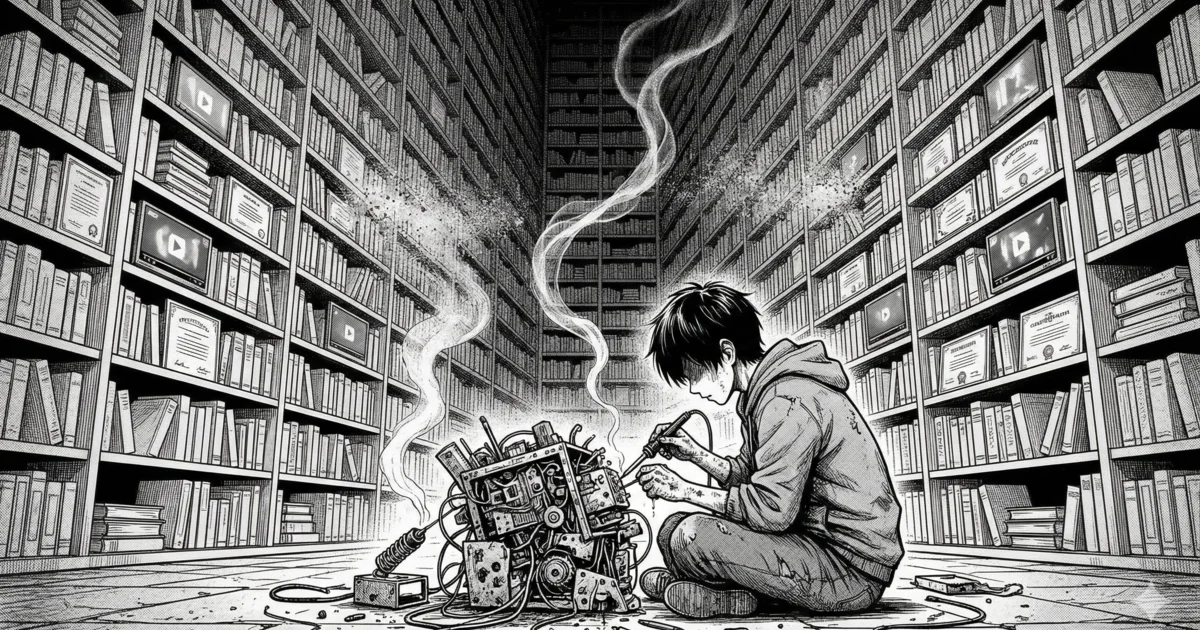
I spent years collecting courses, certificates, and tutorials, and I felt productive the whole time. I wasn't. I was just watching. The real shift happened when I stopped consuming and started building, but it took me a while to figure that out. Let me tell you how.
When I was 15, I was curious about technology. I devoured magazines about electronics, mechanical engineering, and programming, cover to cover, trying to make sense of what they were saying. I didn't understand most of it, but I was hooked. I even printed out guides about capacitors, resistors, and how to build simple circuits. I had no idea what any of it meant, but I was excited to have those guides in my hands.
Oh, and all of this was in English. I'm a native Spanish speaker, and I was reading everything in a language I barely understood. I even forced myself through "Angels and Demons" by Dan Brown, it took me months. I wasn't practicing English, though. I was collecting words the same way I was collecting courses, without ever using them in a real conversation.
Nobody pushed me to do this. I was just curious about how things work. At that age, I felt I was learning a lot, but looking back, I realize I was consuming information without ever applying it.
At 15, I didn't know what I was doing. But that curiosity, even without direction, put me in the room where I'd eventually learn.
You don't need a plan. You need a pull.
The collection trap
Later at college, I fell into the trap of stacking certificates. Sustainable Urban Development on edX. Leadership for Engineers. Big Data Foundations from IBM. One by one, without stopping. I thought that by finishing them, I was learning, but honestly, I wasn't applying any of it.
You probably know the feeling. The bookmarks folder full of saved tutorials you'll "get to later." The course you finished but can't remember a week after. That sense that you're moving forward, even though nothing you build has changed.
I had a lot of certificates, but I didn't have any real skills. I was a spectator at a game, not a player.
But you know what I actually learned? Electronics, programming, robotics. Why? Because I spent hours building things, breaking them, and fixing them. At UCV (Universidad Central de Venezuela), we didn't have resources. I built robots from salvaged printer motors and bearings. That constraint forced me to actually understand how things worked, not just follow instructions. If you only have scrap, you can't copy a tutorial step by step. You have to think.
I definitely read a lot, but the reading was tied to doing. That's the difference.
Saying yes before you're ready
After college, I worked as an electrical engineer. But the situation in Venezuela was getting worse, and I began looking for other opportunities. I'd always been interested in programming. I'd even built an Android app to control IoT devices. I thought I had enough experience.
In the interview for my second job, one of my future bosses asked if I had experience with web development. I said "yes." I didn't. But I got hired anyway, and that's where I discovered Laravel, a PHP framework. I had to build the main website for the company. Suddenly I needed to learn about databases, servers, and everything that comes with web development. There was no tutorial to follow. I had to figure it out.
If you've ever said "yes" to something you weren't ready for, you know that feeling. It's terrifying, but it's also when you learn the fastest.
That's when I fell into a cycle that changed everything: read, build, hit a wall, go back and read with better questions, build again. That cycle is what made me learn.
Doing is where the real questions live
When you build something, things break. Your code throws an error you've never seen. You spend three hours on something that should take ten minutes. You Google the same question five different ways and still can't find the answer. You feel like you're not good enough, and you want to give up. But then you get obsessed with solving that problem, and you start asking questions, looking for answers.
That's where the real learning happens. Courses give you answers to questions you haven't asked yet. Building forces you to ask them yourself.
I got to the point where, if I don't have that uncomfortable feeling, I get uncomfortable. That discomfort is the signal. If everything feels easy, you're probably just watching.
This applies to everything, not just programming. Last year I started training for triathlons. I grabbed the best books and courses, but this time I applied what I read by training.
After my first long run, I went back to the training book with a completely different question: not "how do I run faster" but "why do my knees hurt after mile three." Every run, every ride gave me better questions to bring back to the material. I'm still learning, but I'm in a much better spot than a year ago.
How to start
If you're not struggling, you're not learning. If you're not learning, you're just watching.
Close the tab. Go build something ugly. You'll learn more in one broken project than in a hundred finished courses. That 15-year-old kid printing capacitor guides he couldn't read? He was onto something. He just needed to pick up a soldering iron.