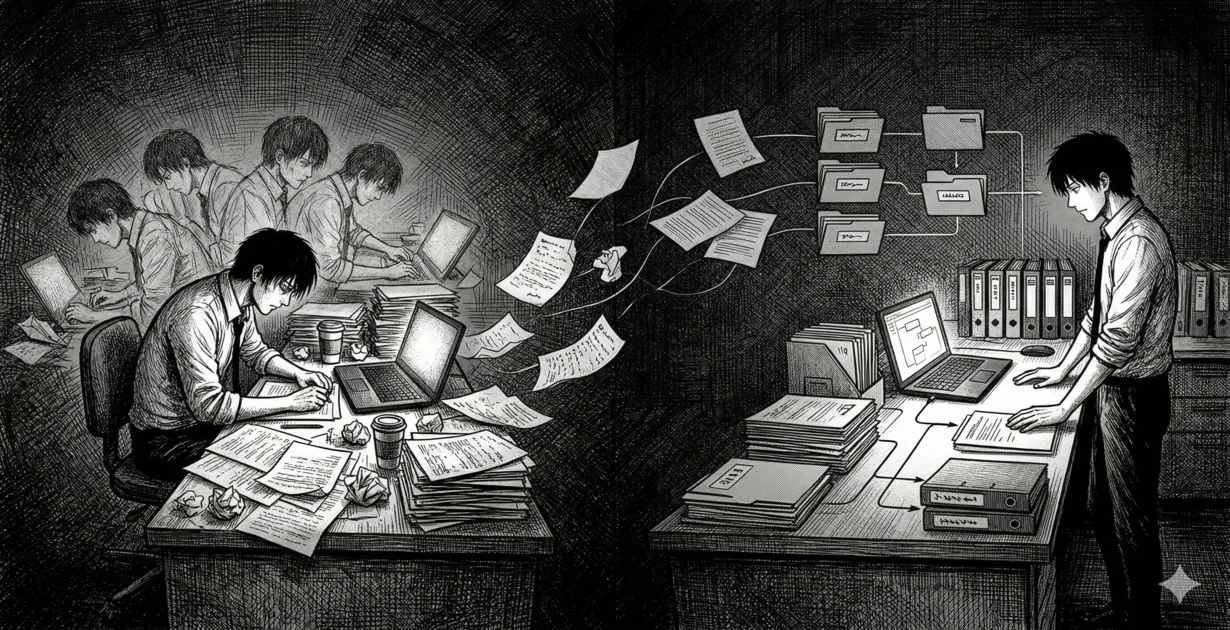
The loop you don't know you're in
What happened with that CV isn't unusual. OpenAI found that over 70% of ChatGPT conversations are for personal, everyday tasks like this. The most common pattern is the same one my girlfriend followed: type the whole request, hit enter, hope for a good result. One query, one answer. Like a search engine, but expecting something more.
Most people never follow up. They don't break the request into pieces, don't provide context in stages, don't iterate. When the result disappoints, they try again with slightly different words. Or they give up.
There's a name for what's happening here.
In 1942, psychologist Abraham Luchins ran an experiment. He gave people a series of puzzles where they had to measure exact amounts of water by pouring between jugs of different sizes. There was a method that worked, a complicated one involving multiple steps, and he taught it to them. After several rounds, they had it down.
Then he gave them a new puzzle. This one could be solved in two simple pours.
70% kept using the complicated method. They couldn't see the simple one. Their experience wasn't helping them anymore. It was blocking them.
The control group, people who never learned the complicated method, solved it immediately. Zero percent failure.
Luchins called this the Einstellung effect: your familiar approach doesn't just guide you, it blinds you to better alternatives.
But here's what makes this study remarkable. When Luchins warned them, "Don't be blind," over half switched to the simpler method right away. Awareness alone was enough to break the pattern.
Psychologists Kruger and Dunning found a compounding problem: people scoring in the bottom 12th percentile estimated themselves at the 62nd. The same gap in skill that causes bad results prevents you from spotting them. So the loop tightens. You don't just repeat a bad approach, you can't tell it's bad.
When my girlfriend got a generic CV from Claude and concluded the tool wasn't useful, both effects were at work. Einstellung kept her locked into one approach: share everything at once, hope for the best. And she couldn't see that the input, not the tool, was the problem.
The good news from both studies: these aren't permanent conditions. Awareness breaks the first. Practice breaks the second. You can learn both.
Zoom out
So you're stuck in a loop. You know it now. The question is: what do you do about it?
Most advice says: "Break your problem into smaller pieces." "Give AI one task at a time." That's not wrong. But it's incomplete. It's like telling someone lost in a maze to take smaller steps. The steps aren't the problem. You need to see the maze from above.
That's the move. Zoom out.
Breaking a problem into pieces is useful. It answers the question "how": how do I take this big thing and make it manageable? But there's a second question that matters more: "why." Why does each piece exist? How do the pieces connect to each other? And can you arrange them so the whole thing works again and again, not just once?
The first question is decomposition. The second is systems thinking.
Donella Meadows, one of the most influential thinkers on this subject, defined a system as "a set of things, people, cells, molecules, or whatever, interconnected in such a way that they produce their own pattern of behavior over time."
She had a concept she called leverage points: places in a system where a small change produces a large shift in behavior. In some Dutch housing developments, the electric meter was in the basement. In others, it was in the front hall where you'd see it every day. The houses with visible meters used 30% less electricity. Same houses, same people, same appliances. One small structural change, making information visible, shifted the entire system's behavior.
That's the difference between fixing a problem and redesigning how the problem gets solved.
This kind of thinking has a long track record. When Albert Einstein was 16 years old, he asked himself one question: "What would I see if I rode alongside a beam of light?" He didn't try to rethink all of physics at once. He isolated one specific paradox and followed it. That single thought experiment, focused and small, revealed a contradiction in classical physics that eventually led to the theory of special relativity.
In 1945, mathematician George Polya published How to Solve It after decades of watching students struggle. He noticed the same pattern: people jump to solutions without understanding the problem first. His four steps:
- Understand the problem. What do you know? What are you trying to find? What's missing?
- Make a plan. Can you break it into parts? Can you solve a simpler version first?
- Execute the plan. One step at a time. Check each step before moving on.
- Look back. Did it work? Can it work better? What would you do differently?
Research published by the National Academies Press, comparing expert and novice problem-solvers across chess, medicine, and physics, confirms this. Experts spend significantly more time understanding the problem and reflecting on their approach. Novices jump straight to execution. Experts aren't smarter. They've learned to pause, see the structure, and work with it instead of against it.
How she built a system
Here's what changed with the CV, and it wasn't a prompting trick.
The first step was to understand the real problem. Not "I need a CV." The real problem: she needed to produce tailored CVs quickly, for many different job posts, without starting from scratch each time.
That's not a single task.
That's a system.
Step 1: Decompose. We broke the process into its actual parts:
- Her experience, education, skills, and courses
- The CV strategy she'd researched
- The specific job post she was applying to
- The design template she wanted to follow
- The final output (a formatted CV)
Step 2: Connect. We figured out how the pieces feed into each other. The strategy determines how experience gets presented. The job post determines which parts to emphasize. The template determines how it looks. Each piece has a role, and they have to flow in the right order.
Step 3: Systematize. We made each piece reusable:
- A folder with her full experience in simple, editable files she can update anytime
- A strategy file capturing all her research and the approach she chose
- A folder for job posts, each with the posting and the output CV for that application
- Template images showing the design she wants
- Claude generates the content based on all of this, then produces an HTML that matches the template and exports to PDF
Now when she finds a new job post, she drops it in the folder and asks Claude to generate a new CV. The experience files are already there. The strategy is already there. The template is already there. What used to take hours takes minutes.
She didn't learn a better prompt. She built a system.
The same three moves, decompose, connect, systematize, work for anything with moving parts. A content calendar. A product launch. A kitchen renovation. An event plan. The pieces change. The pattern doesn't.
What AI actually reveals
When you give AI a vague request and get a vague answer back, you're seeing something that was always true but hard to notice. You're watching, in real time, what happens when you skip the thinking step. The feedback is instant and obvious in a way it usually isn't when you're working on your own.
That's what AI reveals. Not that you need a better tool. Not that you need a better prompt. But that the way you approach problems, any problem, determines the quality of the result.
She wasn't doing anything wrong. She was doing everything the hard way. Researching, creating, formatting, repeating. Every piece was good. But she was solving the same problem over and over instead of building something that solves it for her.
Now she has a system. New job post, new CV, minutes instead of hours. The thinking happened once. The system keeps working.
That's the real skill. Not perfection. Not a better prompt. It's seeing the system. Decompose it. Connect the pieces. Make it repeatable. Solve it once, and it works forever.
That skill doesn't belong to developers or engineers. It belongs to anyone willing to stop, think, and build something that lasts.