Project № X · Case study

MoonGuard — a Laravel monitor we put down

An open-source Filament plugin for monitoring Laravel applications in production. One dashboard watched many apps at once — uptime, SSL validity, server health, and exceptions — and paged the on-call over email or Slack when something drifted. Shipped alongside a companion agent, a desktop debugger, and a free book that documented the package-building journey end to end. The code remains on GitHub; the marketing site does not.

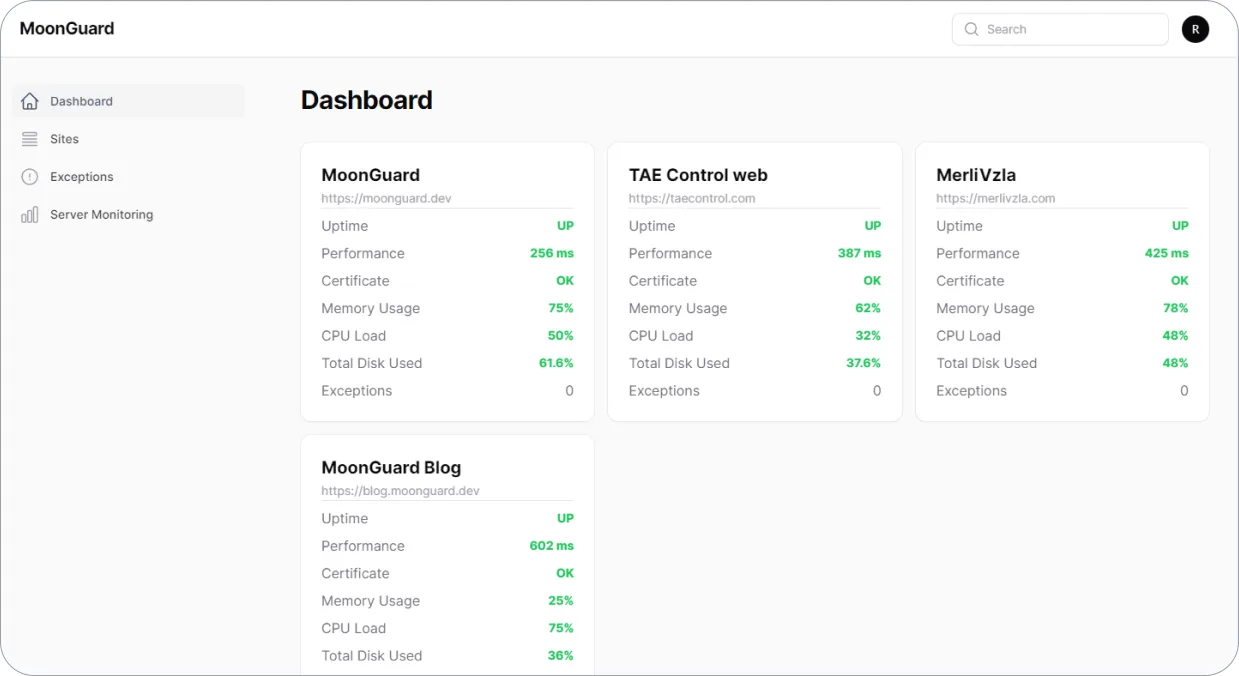
MoonGuard Filament dashboard showing four Laravel sites — MoonGuard, TAE Control web, MerliVzla, and MoonGuard Blog — each with uptime, performance, certificate, memory, CPU, disk, and exception readings.
Fig. IThe Filament panel, watching four sites at once — uptime, SSL, server health, and exceptions in a single view.
I.Problem

Production monitoring for small Laravel shops is either too much or too little.

The small team running a handful of Laravel apps sits in an awkward gap. On one side are the enterprise observability suites — powerful, pricey, and calibrated for a fleet you do not yet have. On the other side are ad-hoc cron jobs and a Slack channel full of curl errors that nobody reads on Sunday. What was missing, for the two-developer agency with six sites in production, was a single dashboard that watched uptime, SSL, exceptions, and server health across all of them — and that one could install with a Composer require and a migration.

The target was a small, honest tool: one Filament panel, many apps, and a notification that arrives before the client calls.

II.Approach

A Filament plugin for the dashboard, a companion package for the metrics, a desktop app for the debugger.

MoonGuard was a Filament plugin — installed into a Laravel app, it gave the operator a panel for registering sites, scheduling checks, and reading incidents. Uptime and SSL probes ran on a cron; exceptions and server metrics were reported in by the monitored apps themselves. Notifications were pluggable, with email and Slack shipped out of the box. The plugin owned the schema, the UI, and the alerting; the monitored apps owned only the small act of reporting.

The reporting side lived in Larvis, a lightweight companion package installed into each monitored Laravel app. Larvis forwarded exceptions and server telemetry — CPU load, RAM usage, disk space — to the MoonGuard host over HTTP, and spoke the same protocol that Krater, a cross-platform desktop app, used for local debugging. Three pieces, one vocabulary: the Filament plugin as the panopticon, Larvis as the sensor, Krater as the developer's local lens on the same data.

The fourth piece was the one that surprised people. The package was accompanied by a free book — MoonGuard: The Software Creator's Journey — that documented the end-to-end process of conceiving, building, and publishing a Filament plugin, with code examples drawn directly from the repository. The package and the book were written in parallel; each kept the other honest.

III.Outcome

Shipped, open-sourced, and eventually set down.

3
Coordinated packages — MoonGuard, Larvis, Krater
MIT
License; still installable via Composer from Packagist
1
Free companion book on building the plugin

MoonGuard shipped as taecontrol/moonguard on Packagist and as an open repository under MIT. It watched multiple Laravel apps from a single Filament panel, probed uptime and SSL on a schedule, ingested exceptions and server metrics over Larvis, and notified by email or Slack when thresholds tripped. The active release arc was narrow and dense: v1.0.9 added Slack integration in November 2023, v1.1.0 followed two weeks later with maintenance-mode indicators and automatic exception cleanup, and v1.2.0 landed full server monitoring — CPU load, RAM, disk — in February 2024, the same window in which Krater grew an OpenAI-backed query assistant and split into a free and Pro tier. The code is still where it was — the repository remains public and installable, and the blog at blog.moonguard.dev stays online as an archive of the build — but the marketing site, the docs site, and the book at moonguard.dev have been taken down along with the domain.

The more interesting outcome was the one that was never in the product spec: the book turned the repository into a teaching artifact. People who installed the plugin read the book; people who read the book installed the plugin. The code and the prose reinforced each other in a way that pure marketing copy never does — and that, in the end, is the part of the project I am proudest of.

IV.Retrospective

Writing the book while writing the package was the decision that paid.

Three choices still feel right. First, committing to Filament as the host surface. The plugin did not try to be a standalone SaaS; it was a panel inside the operator's own Laravel app. Installation collapsed to a Composer require and a migration, and the UI inherited everything Filament already knew how to do. The leverage, for a small team, was substantial.

Second, splitting the system into three packages rather than one. MoonGuard owned the host and the UI, Larvis owned the reporting agent, Krater owned the local developer experience. Each had its own release cadence, its own scope, and its own README. The seams showed up as work — a shared protocol, three repos to keep synchronised — but the boundaries kept each piece small enough to reason about.

Third, writing the book in parallel with the code. Every chapter drafted against an unwritten feature surfaced a rough edge; every refactor that made the chapter easier to write made the package easier to use. It is the closest I have come to documentation-driven development actually working.

What I would do differently is the release cadence and, with it, the quiet middle period that turned into the end. Between November 2023 and February 2024 the project shipped four meaningful releases in a row; after v1.2.x the tempo collapsed, and the package sat dormant while other Taecontrol priorities took the room and the open issues and PRs accumulated in the gap. A monitoring package that asks users to trust it in production cannot afford a silent year; by the time we might have come back to it, the site was already down. The repository stays up as a record — and the book, if it finds a new home, will stay with it.